'She's mine, even at the hotel' — ownership as the engine in long cuckold marriages
The engine that rarely gets named directly and that runs at the centre of long-married arrangements. What "she is mine" actually means in this register.
New here? The words — what cuckolding, hotwifing, FLR, chastity, bull, architecture, engine, and the rest of the vocabulary on this site actually mean.
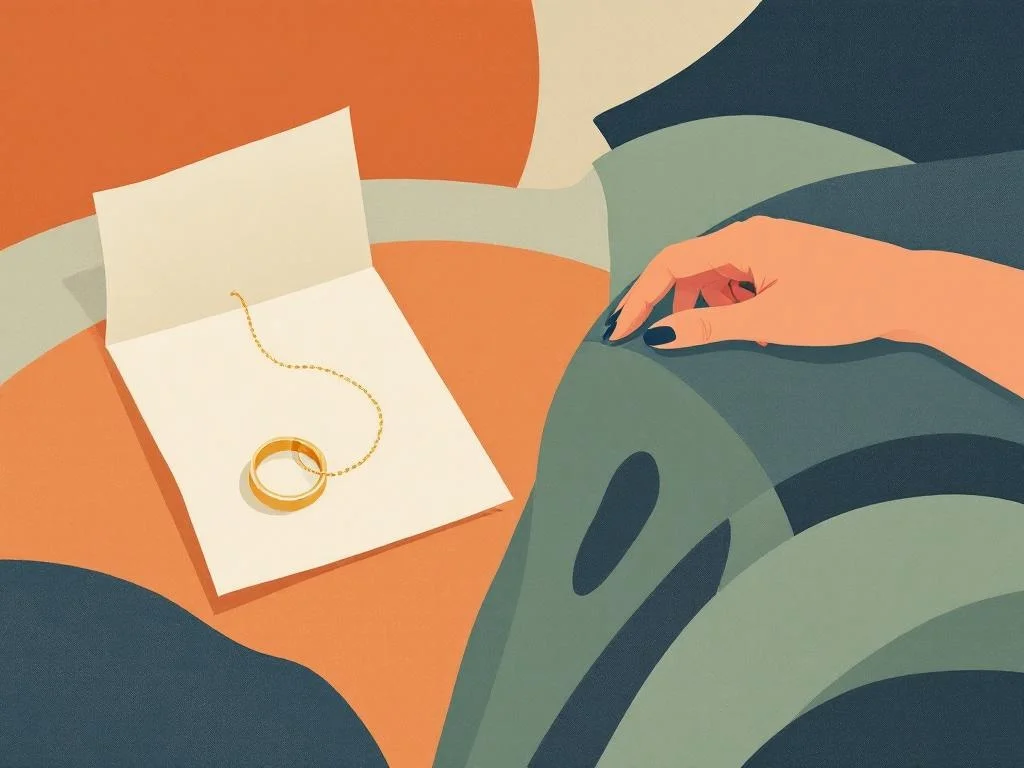
The ring stays on. She walks through the door of the hotel room and her left hand is the first thing the bull notices and is meant to. Of the engines that run an asymmetrical marriage — our term for cuckolding, hotwifing, female-led arrangements, chastity, and the configurations near them, where one partner holds an explicit unequal role by agreement — the ownership engine is the one the public conversation rarely names directly. Not because practitioners don't run on it. They do. This engine sits at the centre of a meaningful share of long-married arrangements. The discourse skirts it because the available language — claim, mark, possession, mine — sits uncomfortably close to coercion in a culture still working out what consent and ownership can mean in the same sentence. So the engine runs, and the practitioners describing it use careful adjacent language, and the framework piece that names it has been waiting to be written.
We define an "engine" the way the rest of this publication does — the underlying psychological driver, the thing that makes a particular configuration feel charged for a particular couple. Most couples in asymmetrical dynamics run on a stack of two or three engines, with one clearly dominant. Ownership is one of them. It's structural, consent-based, and the engine that most often holds long arrangements together when the more theatrical engines have quieted.
What we mean by ownership, and what we don't
To name the thing clearly: ownership in this engine is figurative, theatrical, architectural. It is the experience — desired and consented to by both partners — of being someone's, of being claimed, of being marked as belonging within a particular marriage even while moving through experiences that involve other people. It is the husband who introduces his wife as my wife with extra weight on the possessive. It is the wife who keeps her ring on through the encounter and notices the bull — the lifestyle term for a man who has sex with another man's wife with the husband's knowledge and consent — registering it. It is the small chain or anklet or implicit signal she still wears that says, even here, even now, I belong to him.
What this is not: literal ownership. Not the right to override her choices. Not the absence of agency. Not coercion, not control, not the structures the word ownership carries in ugly historical registers. The ownership engine in an asymmetrical marriage is consent-based affirmation — a chosen language between two adults who use the symbolic register of belonging because that register is where their charge lives. It can be withdrawn at any time. It is, in the durable arrangements, frequently revisited and re-consented to. It is the wife's claim on the husband as much as the husband's claim on the wife; the engine runs in both directions, even when one direction is the louder one in any given moment.
The signals practitioners actually describe
Across long-running threads on r/HotWifeLifestyle, in the OurHotWives.org forums, and in the marriage-side accounts on EvolvingYourMan, the same small inventory of signals shows up. The wedding ring kept on. A specific necklace, often given by the husband, that she wears when she is going to meet a bull. An anklet — a quieter signal some couples use, sometimes coded, sometimes not. The way the husband sees her off and the small ritual that closes the door. The text she sends from the hotel that names where she is and who she's with and uses the possessive in the husband's direction (your wife, yours). The way the bull is told, explicitly or by atmosphere, that the wife arrives married and leaves married and the marriage is the frame his evening sits inside.
None of these signals are dramatic. The discourse on cuckolding online tends to fixate on louder markers — collars, tattoos, photographic claims — because the louder markers are the ones porn shows. What the threads describe is quieter. The signals practitioners run on, in the long arrangements, are often invisible to anyone but the three people who know what they mean. That invisibility is part of the point. The claim is real because it's private and because it's held without theatre. A ring is a ring; a ring she keeps on through an evening with another man is a ring doing structural work.
Why this engine runs at the centre of long arrangements
A pattern in the threads, durable enough to be called a pattern: arrangements that survive past year three, past year five, past year ten almost always have ownership running somewhere in the engine stack. Often as the primary engine, often as the secondary one alongside submission or reclaiming, occasionally as a quiet tertiary that holds the architecture together when the louder engines have moved through their cycles. The reason is structural. Ownership is the engine that affirms the marriage through the practice rather than asking the marriage to tolerate the practice.
Think about what the engine actually does. Each encounter, each evening with a bull, each time the architecture is exercised, the ownership engine is being fed by the marriage holding. The ring stays on. The husband is still her husband when she comes home. The bull leaves and the marriage closes around the night. For couples whose engine runs primary on ownership, the practice is not a thing the marriage permits — it is a thing the marriage uses, deliberately, to affirm itself. The encounter is the friction; the marriage holding through the encounter is the charge. The engine fires on the gap between what could happen — drift, attachment to the bull, the marriage failing — and what does happen, which is the marriage continuing.
The engine fires on the gap between what could happen and what does happen — between the drift the encounter could produce and the marriage that continues to hold through it.
This is why the engine runs long when other engines have quieted. Novelty fades. Voyeurism — charge from witnessing the encounter or hearing about it in detail — saturates eventually for many couples. Humiliation has hard limits the threads describe elsewhere on this site. Submission can deepen but can also stabilise into a quieter daily form. Ownership doesn't fade. The marriage holding through the practice is the engine's only fuel, and the marriage is the one renewable resource the architecture has.
How the bull's role looks from inside the engine
The bull, for couples running on the ownership engine, is not the centre of the evening. He is the friction the engine needs to fire. Practitioners describe choosing bulls who understand this — bulls who know the husband is the architecture, that the marriage is the frame, that the wife arriving married and leaving married is the entire shape of the evening. The bulls who don't understand this — who try to compete, who try to claim, who text the wife in the days after, who fail to leave space for the marriage to close — are the bulls these couples retire fastest.
A subset of bulls appear to understand the engine intuitively. Threads on the bull side describe respect for the wedding band, deference toward the husband, a deliberate choice not to interrupt the architecture. The same subset describes the role with a kind of professional pride — being trusted with someone's wife, knowing the marriage is the larger thing, being a guest in something the husband architects. Couples whose ownership engine runs primary tend to retain bulls like this for years. The bull is part of the architecture's furniture; the marriage remains the building.
Where the engine fails
The ownership engine fails in two predictable directions, and the threads describe both. The first failure is when ownership tips toward control — when the husband's claim becomes the husband's leash, when the symbolic register slides into actual restriction, when the wife's agency is being thinned rather than affirmed. The engine cannot run on coercion. The moment she is staying married because she has to rather than because she chooses to every day, the engine has no fuel. The signals stop signalling. The ring stops working.
The second failure is the opposite — when the practice drifts into something that doesn't affirm the marriage at all. The husband stops sending her off; the bull starts texting; the encounters happen without the architecture closing around them. The ring is still on, but no one is seeing it as load-bearing anymore. The marriage is being run alongside the practice rather than through it. The engine starves quietly. Couples in this drift describe the practice feeling flat without being able to name why; what's missing is the structural affirmation the engine was running on.
Between those two failure modes is the wide centre where the engine actually runs. Most long-arranged couples find their way to it through revision rather than design. The ring kept on, and noticed. The husband consulted, and consulted again. The bull retired when the bull stopped fitting the architecture. The signals adjusted as the marriage adjusted. The engine is patient — it accommodates renegotiation, accommodates pauses, accommodates the wife and the husband each moving through phases where the claim feels different. What it does not accommodate is the claim being faked.
The wife's side of the claim
One thing the public conversation about cuckolding online routinely misses, and that the practitioner forums consistently surface: the ownership engine is at least as alive for the wife as for the husband. Wives in long-running threads describe the ring, the necklace, the husband's claim on them, as part of why the practice is charged for them at all. They describe the encounters as more arousing because the marriage is the frame, not less. They describe the bull as a guest in the architecture, not a replacement for the husband. They describe being his wife as a turn-on independent of the encounter — sometimes more than the encounter itself.
This shows up in the threads where wives describe deciding to stop a particular encounter midway, or to retire a bull who has tried to interrupt the architecture, or to insist on a particular ritual the husband had quietly stopped maintaining. The wife is the engine's caretaker as often as she is its object. When the husband forgets to claim, she often reminds him. When the bull tries to compete, she often shuts it down before the husband notices. The engine runs because both of them are tending to it, and the symbolic register of his wife is something they both know is doing work.
How to know if this is your engine
The diagnostic question, drawn from the threads where couples describe figuring out their stack: when you imagine the encounter, what is the moment you keep returning to? If the moment is the encounter itself — the act, the body, the sex — you're likely running on physical, novelty, or voyeuristic engines. If the moment is the comparison — the placement, the smaller, the lesser — you're running on humiliation. If the moment is her pleasure as the centre, you're running on compersion: pleasure in your partner's pleasure with someone else, jealousy's opposite number. If the moment is what happens after — taking her back, reclaiming the body — you're running on reclaiming, which is its own engine and its own piece on this site.
If the moment is the door closing behind the bull and the marriage holding, the ring still on, the husband still her husband, the architecture intact through the friction — you're running on ownership. The encounter was the test. The marriage holding is the charge. Most couples who run on this engine recognise it the moment it's named, and then recognise that they've been running on it for years without having a word for what the engine was doing. The word, whatever its discomforts, is the one practitioners keep returning to. Naming it doesn't make it heavier. It makes the engine legible to the people who have been feeding it without knowing what to call the fuel.
Read the submission engine
The engine ownership most often runs alongside. Charge from her authority — adjacent to, but distinct from, the charge of being claimed.
Read the reclaiming engine
The post-encounter engine. Where the ownership engine speaks, reclaiming acts. Many long-running couples run both.
The engine series, in your inbox.
Each engine, decoded. Submission, voyeurism, compersion, reclaiming, ownership, spectacle — the underlying drivers that make a particular configuration feel charged.
Drawn from a year reading the practitioner forums — long-running threads on r/HotWifeLifestyle, r/CuckoldPsychology and r/Hotwife, the OurHotWives.org and WifeWantsToPlay community boards, EvolvingYourMan, and several practitioner blogs. The framework is ours; the lived reports are theirs. No individual contributor is identifiable from anything published here.