The wife aging into a cuckold or hotwife marriage — fifties, sixties, perimenopause
Perimenopause, libido shifts, the mirror in the morning. The wife who keeps running the practice through the changes, and the changes the practice asks of her in return.
New here? The words — what cuckolding, hotwifing, FLR, chastity, bull, architecture, engine, and the rest of the vocabulary on this site actually mean.
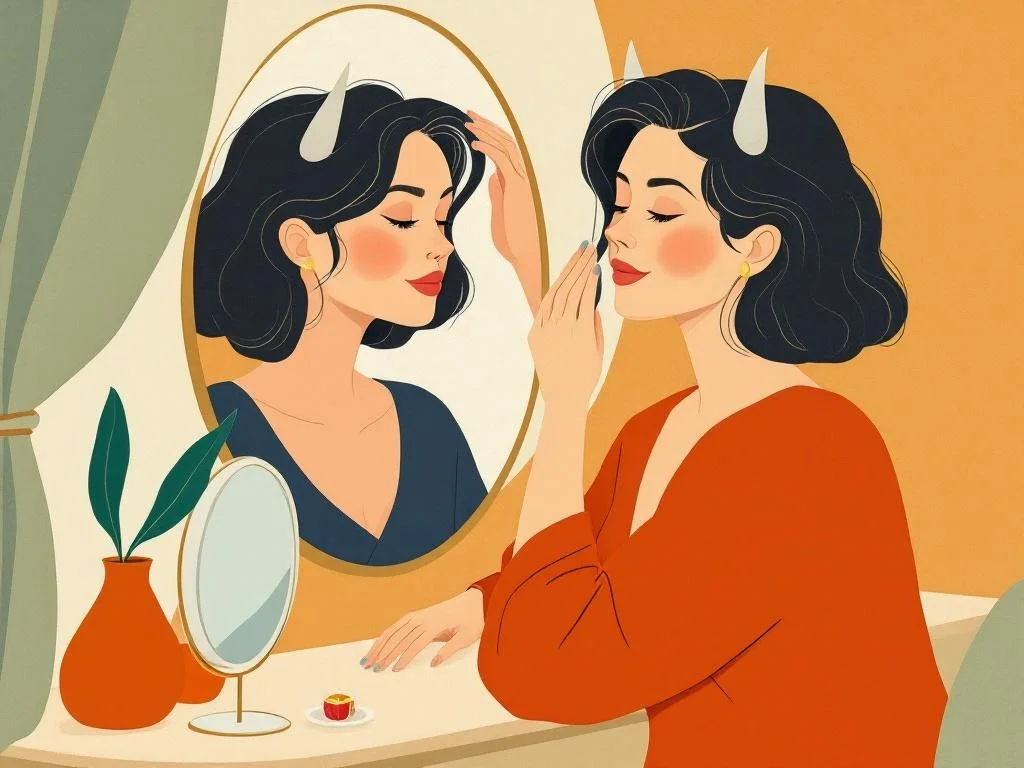
She is fifty-three. The lipstick is the same colour she wore in her thirties; the mouth is not. She catches herself in the hallway mirror on her way out and likes what she sees, which is also new. The practice meets the body across decades. An asymmetrical marriage dynamic — cuckolding (a marriage where a husband has consented to his wife having sex with other men), hotwifing (the closely related, less submission-centred version), female-led relationships, or chastity (where one partner's orgasms are controlled by the other) — that began in the wife's thirties is often, by her fifties, in its second decade. The body is not the body it was. The dynamic is not the one it was either. What we keep finding in the threads written by women running the practice through perimenopause, into menopause, and out the other side is the quietest, most affirming material we've read.
The body's quiet revolution
Perimenopause arrives, often, in the late forties — sometimes earlier. Cycles get unpredictable. Sleep gets unreliable. Estrogen declines unevenly. The vaginal mucosa thins and dries. Arousal takes longer; orgasm sometimes takes longer; the body is asking for more attention, more lubrication, more time. None of this ends the practice. All of it asks the practice to slow down and pay attention in ways the practice in the wife's thirties did not have to.
The threads are matter-of-fact about the toolkit. Vaginal estrogen, prescribed by a doctor — small local doses, not systemic, a real difference for dryness and for sex feeling comfortable again. Lubricant chosen carefully, often silicone-based, kept in the bag and on the bedside table without ceremony. Time, as a feature rather than a bug — the encounters take longer to start, and the wives who run long arrangements describe coming to like that they take longer. Hot flashes, when they arrive, treated as weather rather than failure. The body that is going through this is not a broken version of the previous body; it is a different body that runs by different rules.
The bull pool that stays
Bull is the lifestyle term for a man who has sex with another man's wife with the husband's knowledge and consent. The bull pool flexes meaningfully in this window. The bulls who stay, the threads describe consistently, are the older ones — men in their forties, fifties, and sixties — who treat the wife as the lead rather than the prize. They are not in a hurry. They do not need her body to perform a particular kind of arousal. They have been around bodies long enough to know what a body in its fifties wants from sex, which is often slower beginnings, more talking, more listening, more gentleness early and more directness later, and a kind of attention younger bulls have not yet learned to give.
The bulls who do not stay, in the threads, are usually the ones recruited from the husband's earlier fantasy of the practice — the much-younger man, the gym-cut twenty-something, the bull whose draw was partly the visual contrast with the husband. These bulls often retire themselves, around this point in the arrangement, because the wife is no longer the body they came for. The wives who handle this transition gracefully describe being relieved when the younger pool thins out — the older bulls give them encounters that are more about her, less about the optics, and a quality of presence the younger pool was not yielding.
The cohort of women in their fifties and sixties say the practice in this phase is the most genuinely theirs it has ever been. The body has stopped being the project. The marriage is.
Engines that quiet, engines that deepen
An engine, in this publication's language, is the underlying psychological driver — the thing that makes a particular configuration feel charged for a particular person. Some engines quiet across this window. The engine of being-watched-as-young-and-desired narrows as the wife's relationship to her own visibility shifts; she is not less desired, but she is no longer auditioning. The engine of the husband's specifically-jealous charge often dims; the practice is too established for that register. The engine of newness — new bulls, new encounters, the breathlessness of the first few years — is, by definition, no longer available in the same form.
What deepens, the threads are unusually clear about. The engine of submission, on either side, often becomes more central rather than less. Husbands who came into chastity in their forties often describe the practice in their late fifties as more profoundly the shape of the marriage than it had been in earlier years. Wives who were always a little ambivalent about the dynamic's submissive readings often describe coming into them more fully in this window — not less. The engine of spectacle — the wife visibly in possession of her own sexual life, the husband visibly choosing to be supporting cast — often deepens; the marriage has had years to sediment around it, and the structure feels more like the marriage's actual shape than its dramatic feature. The cohort writes about these engines with a specificity younger threads rarely have.
The mirror in the morning
Wives in this window write about the morning mirror with a particular candor. The body has changed. The face has changed. The grey at the temples is real now. The breasts have done what breasts do; the thighs have done what thighs do. None of this, in the long-running threads, ends the practice or even particularly threatens it. What changes is the wife's relationship to the discrepancy between the body she sees and the body she once had. The threads describe a graceful version of this — the wife who has stopped negotiating with the mirror about whether the practice is still hers to run — and it shows up, repeatedly, in the wives whose arrangements are the longest and the most stable.
What helps, in the threads. Specific physical care — the skin, the hair, the small grooming choices that signal to you that the body is loved, not tolerated. Lingerie that fits the body you have now and is not aspirational. Photographs taken of the body now, in good light, by him or by you, looked at calmly. A relationship to the body that is observational rather than evaluative. If you arrive at this register, the encounters in this window are more present and less performative than the encounters in your earlier years were. The body is no longer the project. The encounter is.
The practice as the most genuinely theirs it has ever been
The most striking thing about the cohort of women writing about the practice in their fifties and sixties is the consistency of their report. The practice in this phase is the most genuinely theirs it has ever been. The husband's earlier fantasies have folded into the marriage's actual shape. The bull pool has stabilised around men who come for the wife as she is. The cadence has settled at whatever pace works for two adults running a long sexual life inside a long marriage. The operations have simplified, because the wife knows exactly which rules she actually needs. The dynamic is, by this point, not a dynamic; it is the architecture the marriage runs on.
Wives in this window are not generally writing rapturous threads. They are writing measured, observational, slightly amused threads about a practice that, by year fifteen or year twenty, has revealed what it is for them. Some of them describe encounters less frequent than they used to be and more memorable when they happen. Some describe the practice in this window as the deepest sexual life they have had. Almost all of them describe a marriage that, after running this architecture across decades, looks back at the early years and sees a marriage that did not yet know what it was building. The body has changed across the years. The body is not the architecture's centre anymore. The marriage is. The wife who has aged in the practice is, by her sixties, often the writer the rest of the forums had been reading without quite realising whose voice they had been listening to all along.
The for-wives series, in your inbox.
The wife after childbirth, the wife aging in the practice, the long arrangements that survive their decades. Twice a month at most.
Drawn from a year reading the practitioner forums — long-running threads on r/HotWifeLifestyle, r/CuckoldPsychology, r/Menopause (where relevant), the OurHotWives.org community boards, and several practitioner blogs by women in their fifties and sixties. The framework is ours; the lived reports — written by wives — are theirs. No individual contributor is identifiable from anything published here.